







If you read the last post, you already know that independent work falling apart is almost never a student problem — it's a system problem.
So let's talk about the system.
Not a complicated one. Not a looks-better-on-paper one. A real, practical structure that all students can learn, follow, and eventually run on their own.
An independent work system is a predictable structure that tells students exactly what to do — and keeps them doing it — without constant teacher direction.
It answers three questions students have every single time they sit down to work independently:
When students can answer those three questions on their own, independent work starts to actually work. When they can't, they wait for you to answer those questions for them — and that's when the whole thing falls apart.
Building an independent work system doesn't mean redesigning your classroom from scratch. It means putting a clear structure in place that students can learn and rely on.
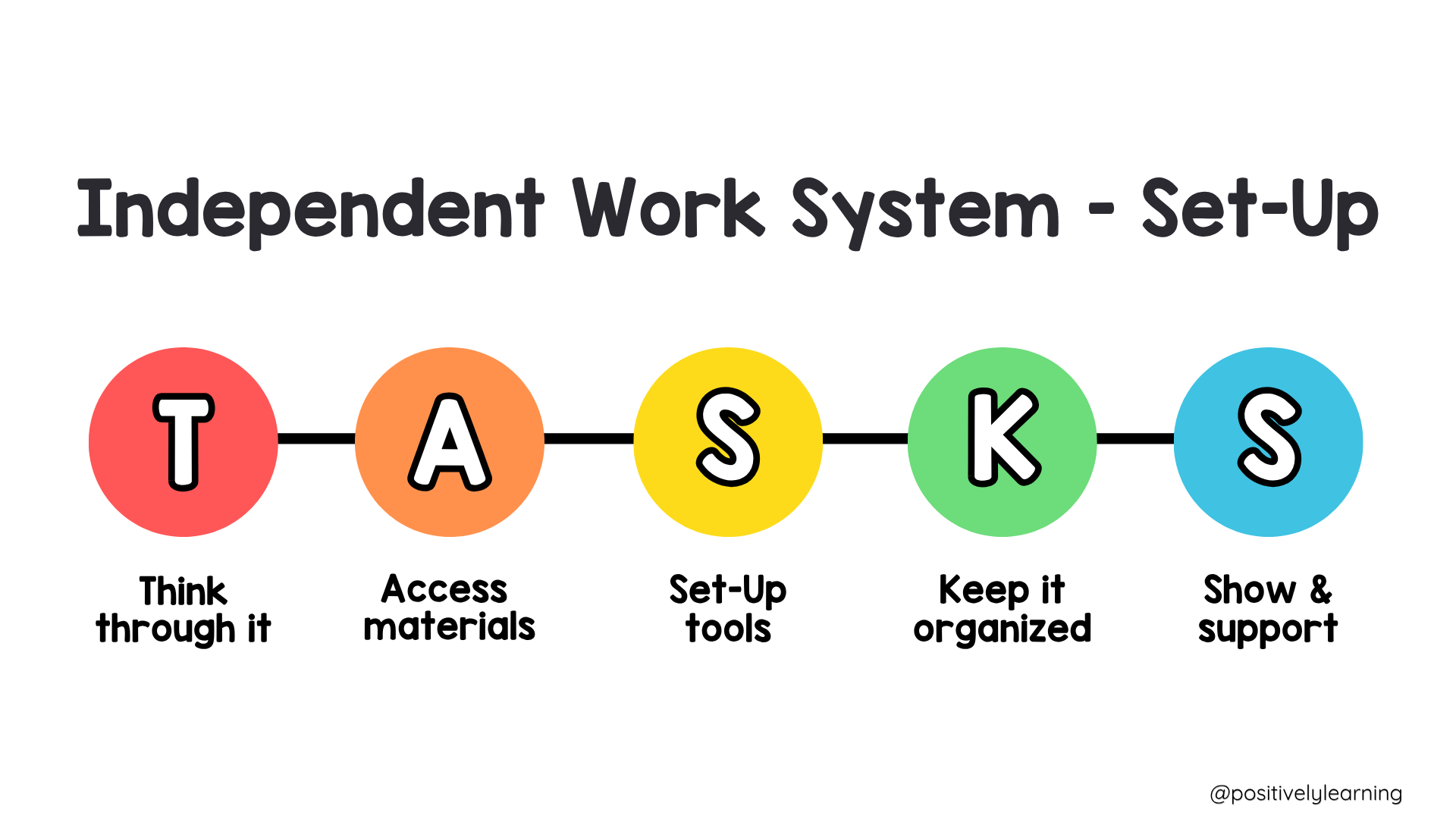
The TASKS framework breaks this down into five components:
T — Tasks that match the student. Independent work only works when the tasks are the right fit. That means tasks students can start and complete without help, at the right skill level, and in a format they understand.
A — A structure students can follow. This is the physical setup — where the work lives, how students access it, and what order they do it in. When the structure is consistent, students stop asking what to do next because they already know.
S — Systems for knowing what's finished. Students need a clear signal that tells them when they're done with one task and what comes next. Without this, “I'm done” becomes the moment everything falls apart.
K — Known routines practiced ahead of time. The routine has to be taught before it can be expected. That means walking students through the process, practicing it together, and giving it time to become familiar before you step back.
S — Sustainability built in. A system that requires you to constantly update, prep, and manage isn't really a system — it's just more work. The goal is a structure that runs consistently without eating your evenings.
An independent work system doesn't have to be elaborate. In many special education classrooms, it looks like this:
That's it. The simplicity is the point.
When students know the routine cold — when they can sit down, find their work, complete it, and know what to do when they're finished — you can step away. You can help another student. You can pull a small group. The classroom keeps moving because the system is doing the work, not you.


|

|

|