









If independent work in your classroom feels like it's always one step away from falling apart — you're not imagining it.
You set it up. You explain it. You remind students what to do. And the second you turn your attention to someone else, the whole thing unravels.
It's exhausting. And if you've been teaching for any amount of time, you've probably started to wonder if independent work just doesn't work for your students.
Here's what's actually happening.
Most independent work struggles aren't about the students. They're about what's happening — or not happening — around the work.
When independent work falls apart, it usually comes down to one of a few things:
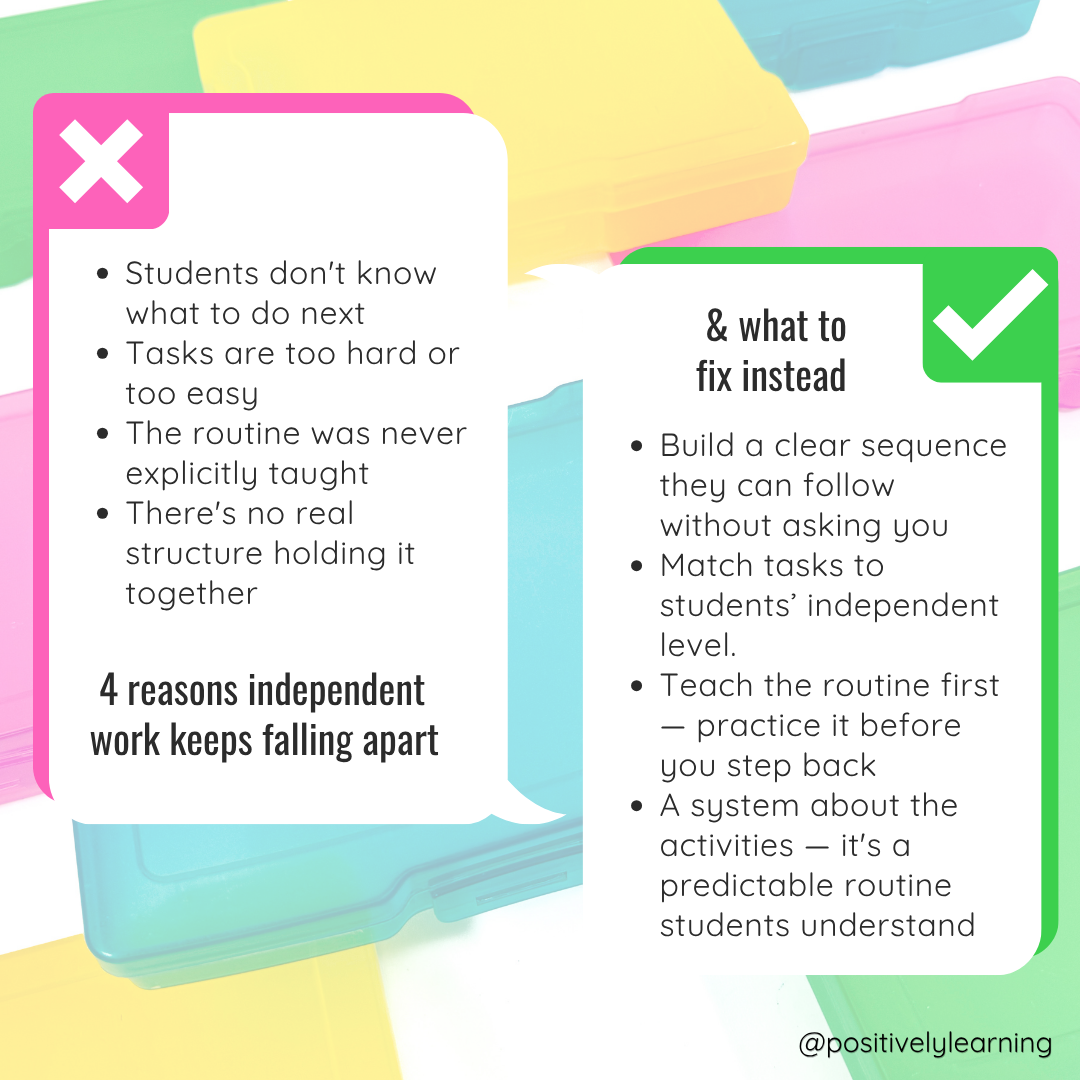
Students don't know what to do next. They finish one task and have no idea what comes after it. So they wait. Or they wander. Or they find something else to do that isn't the work.
The tasks aren't the right fit. If a task is too hard, students get stuck and need help. If it's too easy, they finish in two minutes and then they're done — and now they're your problem again. Either way, you're getting pulled away from what you were trying to do.
The routine hasn't been taught. Independent work isn't something students just figure out on their own. The routine — where to get the work, how to do it, what to do when they're finished — has to be explicitly taught and practiced before it becomes something students can do without you.
There's no structure holding it together. A pile of worksheets isn't a system. A bin of activities isn't a system. A system is a predictable structure students understand so well they can follow it without asking you what to do next.
When independent work isn't working, the whole classroom suffers.
You can't pull a small group.
You can't collect meaningful data.
You can't focus on one student without the rest of the room coming apart behind you.
You spend your day putting out fires instead of actually teaching.
And the longer it goes on, the more it starts to feel like the problem is you — like you're missing something other teachers already know.
You're not missing something. You're missing a system.
The good news is that independent work falling apart is almost always a system problem — and system problems have system solutions.
Once students understand the structure, know what to do, and have tasks they can actually start and finish on their own, the classroom starts to look different. Not perfect. But different.

|

|

|