










You have task boxes printed, prepped, and ready to go.
But when you give a student a task box, they finish it, look up, and wait for you to tell them what to do next.
Now you’re stopping your small group to collect the box, find another activity, and give another direction.
The materials are ready. But the independent work routine isn’t quite there yet.
To use task boxes for independent work, students need a predictable sequence: find the task, complete familiar work, put it in a finished location, and move to the next activity. The task boxes provide the practice. The routine helps students complete that practice with less constant adult direction.
Independent work with task boxes is more than giving a student an activity and asking them to finish it.
A functioning routine helps the student understand:
For example, imagine a student has two familiar task boxes.
The student looks at a visual schedule, takes the first box, completes the activity, and places it in the finished basket.
Then they take the second box, complete that activity, and put it away.
When both tasks are finished, the schedule shows what happens next.
The teacher isn’t responsible for announcing every step. The organization and visual supports help communicate the routine.
Students will need different levels of teaching and support as they learn this sequence. The goal is to make the routine more predictable so they can gradually complete more of it independently.
Before introducing a new independent work routine, choose tasks the student already understands.
This is important because we’re working on two different skills:
If the student is learning a brand-new matching skill and a brand-new work routine at the same time, it can be difficult to know where they need help.
Instead, begin with familiar activities that provide meaningful practice.
You might choose a picture-matching task, a simple sorting activity, or another skill the student has already practiced successfully.
Check that the student can access the materials and understands what completion looks like.
And remember, independent work doesn’t mean a student must do everything without support from the very beginning. You can teach the routine with appropriate support while gradually building independence.
For a more detailed selection process, read How to Choose Task Boxes for Students.
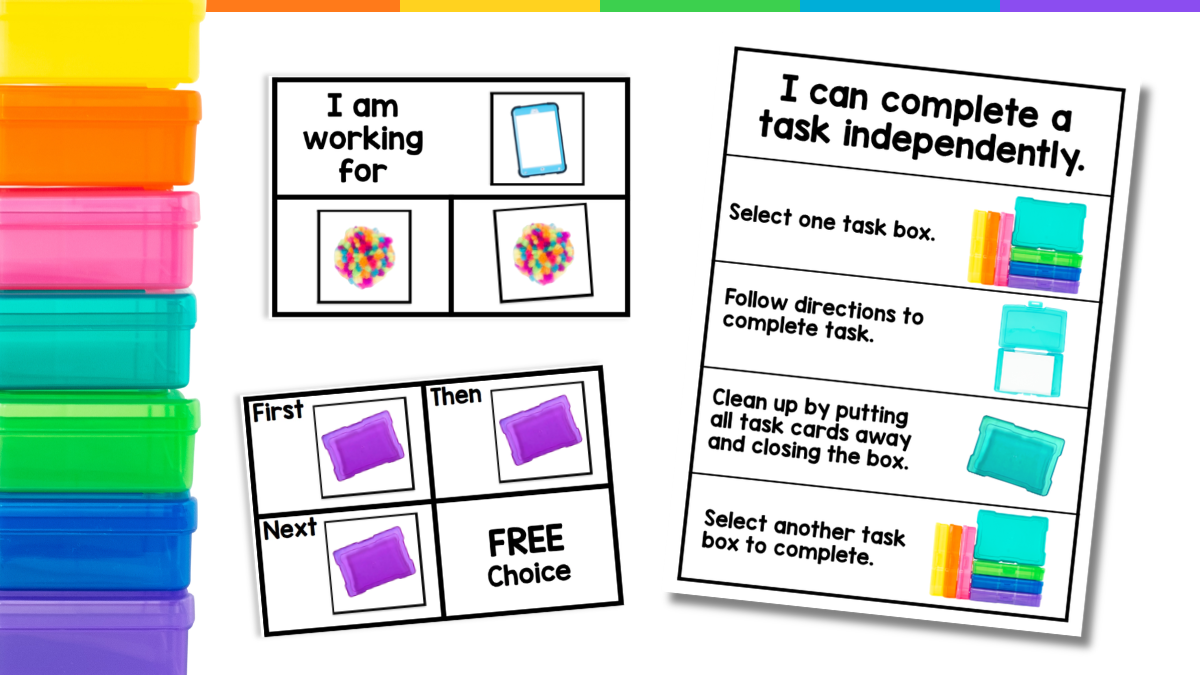
Once you’ve selected the tasks, decide how the student will know what to do first and next.
You might use:
You don’t need every student to follow the same type of schedule.
Choose a format the student understands and can access.
For example, if the student’s schedule shows the numbers 1 and 2, the task boxes should have matching numbers that are easy to locate.
Keep the arrangement consistent while the student is learning.
The important question is: Can a student find the next task without waiting for an adult to tell them?
If the answer is no, look at whether the schedule, labels, or physical arrangement need to be clearer.
This is one of the simplest ways to make the routine more predictable.
Think about what happens after the student finishes the first task box.
Do they hand it to you?
Leave it on the table?
Wait for someone to tell them where it goes?
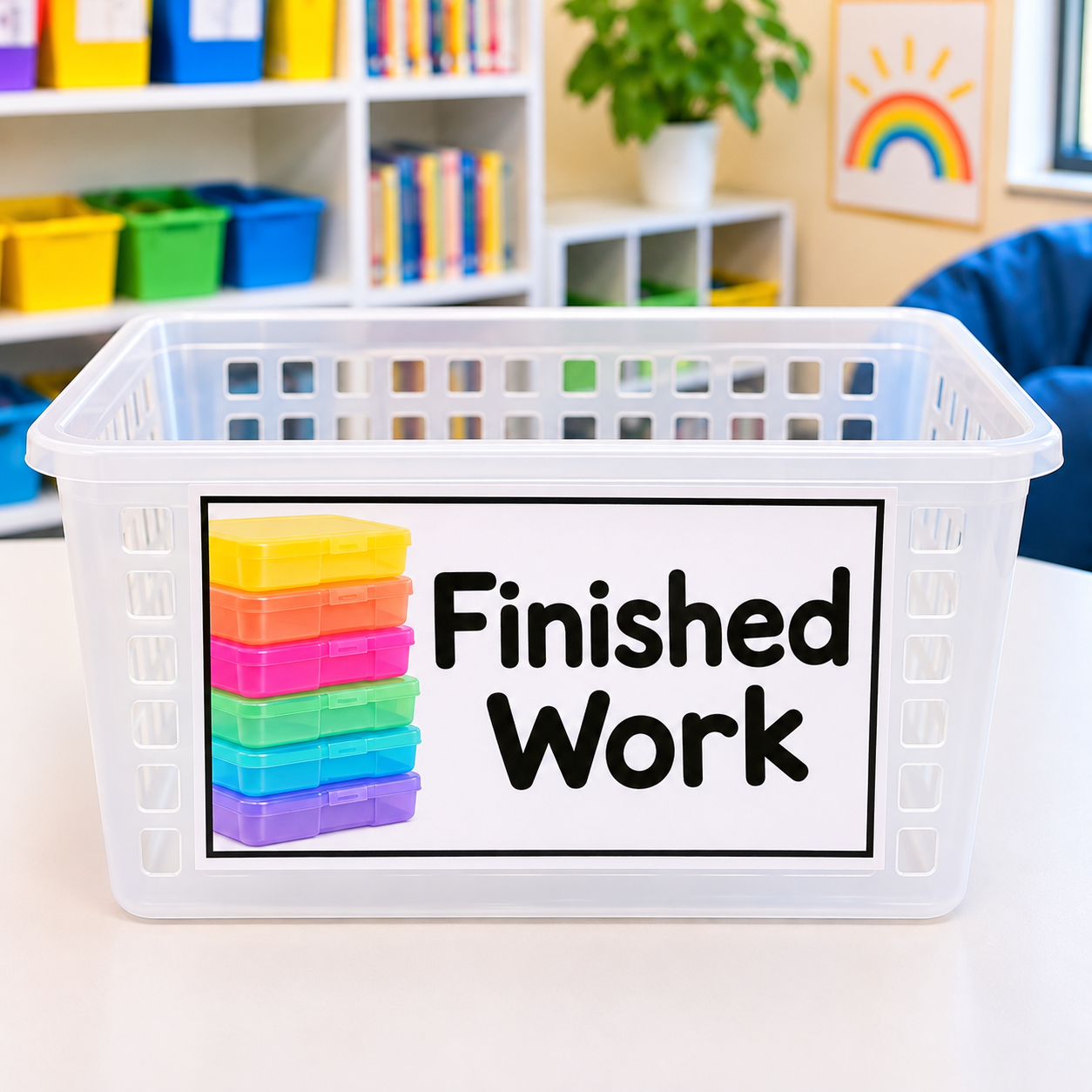
Instead of leaving it up to chance, establish a clear finished location. Maybe it’s a basket, bin, shelf, or designated space on the student’s work surface.
When the student completes a task, they place it in that location before moving to the next one.
For students using a visual schedule, you can also teach them to remove or mark a completed symbol when appropriate.
One very important note for everyone to understand (students and adults!):
Finishing one task box is not necessarily the same as finishing the entire work session.
Students may finish one task and then start another right away. Task boxes are usually a bit shorter for students to experience a “quick win” – in fact, students may even complete three or more tasks in one sitting.
For example:
That gives the work sequence a beginning, a clear amount of work, and an understandable ending.
Now we get to the part that makes the biggest difference.
We need to teach students how to use the system.
Start by walking through the routine with the student.
Show them how to locate the first task, complete the activity, put it in the finished area, and check what comes next.
Practice the sequence using the support the student needs.
You may need to model the steps, point out visual cues, simplify the schedule, or practice one part of the routine several times.
As the student becomes familiar with the sequence, look for opportunities to reduce unnecessary adult directions while keeping the supports that help the student succeed.
For example, instead of immediately saying, “Get the next box,” give the student an opportunity to refer to the schedule.
If the student is still unsure, provide the support they need and consider whether that part of the routine needs more explicit teaching.
The goal is not to stop helping. It’s to help students learn where to find the information they need.
Want to see how all these pieces fit together? Take a look at How to Build an Independent Work System for a simple way to get started.
You don’t need to begin with five or six activities.
A student who is learning the routine may be more successful starting with one familiar task box.
Once that sequence becomes predictable, you can introduce a second task.
For another student, two or three familiar activities might be a reasonable starting point.
The number isn’t the goal.
What matters is whether the student can understand and complete the sequence with appropriate support.
Watch for signs that the routine is becoming more familiar:
You can expand the work sequence as those skills develop.
This is a common place for independent work routines to break down. The student may know exactly how to complete the matching or sorting activity, but finishing the activity doesn’t automatically tell them what to do next.
Before adding another adult prompt, check the system:
Is the next step visible?
The schedule may need a clearer picture, number, or sequence.
Does the student know where finished work goes?
Practice placing the completed task in its designated location.
Is the next task easy to locate?
A box that is hidden, unlabeled, or stored somewhere unexpected may make the routine difficult to follow.
Has the transition been taught?
The student may need additional practice moving from one task to another.
If the student consistently waits after completing the task, that gives you useful information about which part of the routine needs attention.
It doesn’t necessarily mean the student can’t work independently.
You don’t need new task boxes every week to have a useful independent work system.
Familiar tasks can provide meaningful practice, especially while students are learning how to follow the routine.
Instead of changing everything at once, keep the structure consistent and change individual activities when it makes instructional sense.
You might replace a task because:
Try to avoid changing the tasks, schedule, storage arrangement, and finished routine all at the same time.
The goal is predictability – when the set-up and structure stays predictable, students can focus on the work.
Absolutely.
Task boxes can also be used during direct instruction, small groups, centers, fine motor practice, or paraprofessional-supported activities. They also can be used as brain breaks, morning work, calming “resets,” and as progress monitoring tools!
Those uses can be especially helpful when you’re teaching new skills or providing feedback.
But when your goal is independent work, the task boxes need to be part of an organized routine the student can learn to follow.
That’s the difference between having activities available and building a system that supports independence.
Before you put the task boxes out, ask yourself:
You don’t have to build a complicated workstation to answer these questions.
Start with a manageable sequence, practice it consistently, and make adjustments based on what you observe.
Once you have a predictable independent work sequence, you need suitable tasks to use within it.
That’s where Task Box Club can help.
Inside the membership, you’ll find printable task box resources across different skills and levels, so you can select and prepare activities without creating everything from scratch.
You’ll still choose appropriate tasks, teach the routine, and make adjustments for your students.
But having a library of materials available can save preparation time and help you focus on building student independence.
The task boxes provide the work. The routine helps students learn to complete it.
And that’s where independent work starts to become more manageable for everyone.


|

|

|