

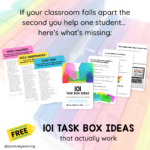








The best task box ideas for special education are short, clearly structured activities students can complete at their independent level. Start with familiar skills such as matching, sorting, counting, beginning literacy, fine motor, functional academics, and life skills.
You don’t need dozens of task boxes in rotation at once. Three familiar tasks can be enough to begin teaching an independent-work routine. Build from there as your students gain confidence and skills.
If your classroom feels like it depends on you to start everything… you’re not alone.
The moment you help one student, the rest of the room starts to unravel. Students are waiting. Asking questions. And independent work doesn’t feel very independent at all.
Good task box ideas start with skills your students already know and can practice with less adult support. Think matching, sorting, counting, beginning literacy, fine motor, functional academics, life skills, and other familiar skills that fit naturally into a clear start-and-finish task.
And you don't need 101 task boxes in rotation at once. Start with a few familiar tasks your students can complete successfully, then build from there.
If students are new to independent work, start with familiar tasks that have an obvious beginning and end and can be completed with minimal support.
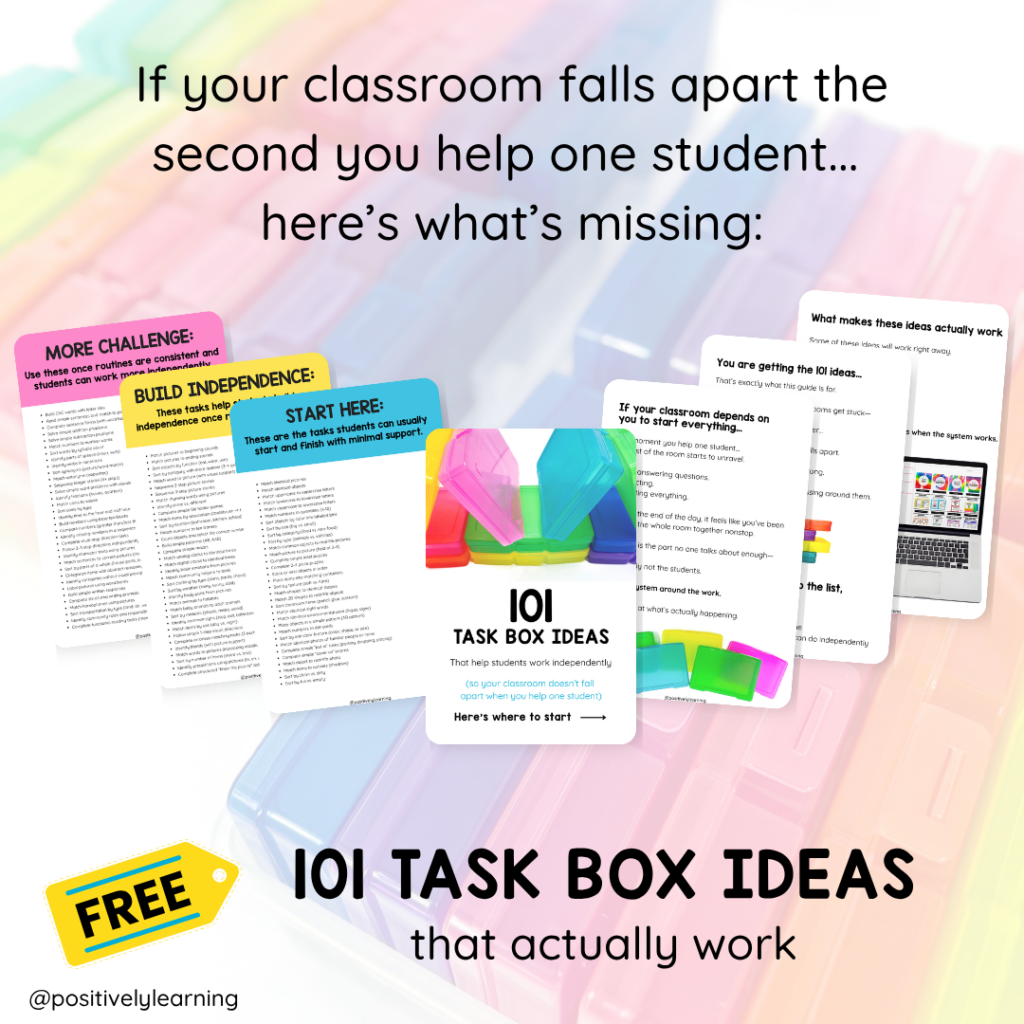
Match Identical Pictures
Match Identical Objects
Match Upper + Lower Letters
Match Numbers to Quantities (5, 10)
Complete Simple Puzzles
Sort Objects by One Clear Features
Once students understand the routine, add tasks that require a little more discrimination, sequencing, vocabulary, or decision-making.
Match Pictures to Beginning Sounds
Match Numbers to Ten Frames
Count Objects + Choose the Number
Sequence 2-Step Picture Stories
Match Items by Association
Follow 1-Step Visual Directions
When students can follow the independent-work routine consistently, introduce more complex academic and functional tasks at their independent level.
Build CVC Words with Letter Tiles
Solve Simple Addition Problems
Build Numbers Using Base Ten Blocks
Identify Missing Numbers in a Sequence
Follow 2–3 Step Directions
Complete Functional Reading Tasks
Task boxes can be a useful part of an independent work system in special education classrooms.
Instead of relying on constant teacher direction, task boxes give students:
That structure is what helps students begin working more independently—even when you’re supporting other students.
Start with what the student can already do—not what you want them to learn next.
For independent work, choose tasks that:
You don’t need to prep all 101 ideas at once. Start with a few tasks your students can already complete successfully, keep the routine familiar, and build from there.
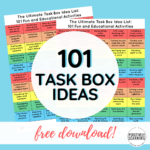
Grab the free 101 Task Box Ideas guide so you have the full list ready whenever you need a new idea.

|

|

|